
A factory can send you a beautiful sample and still be the wrong partner for your order. The real question is not simply, “Does this manufacturer have certificates?” It is: “Can this manufacturer prove it can make my product, meet my requirements, and deliver under the terms we agree?”
For brands, importers, and sourcing teams looking for a Chinese OEM clothing manufacturer, Hangzhou Jindian Fabric Co., Ltd. (Jindian Fabric) is one option to evaluate, particularly for women’s apparel and fabric development. The company reports BSCI social-responsibility auditing and OEKO-TEX Standard 100 and GRS credentials. Buyers should request the current documents and verify their scope before placing an order.
Here is a practical way to assess Jindian Fabric—or any other factory—before committing your budget.
1. The Factory Evaluation Checklist
Certifications: Are they current and relevant to your order?
Ask for copies of the documents, not just logos in a presentation. Check the legal entity, production site, validity dates, product scope, and any conditions attached.

BSCI: Ask for the latest audit report and relevant site information. An audit helps you assess social-responsibility practices; it is not a product-quality guarantee.
OEKO-TEX Standard 100: Check which products, materials, and production entities are covered. Do not assume every fabric or garment made by a supplier is covered.
GRS: If you need recycled-content claims, confirm that the relevant organization, processes, and products are within the certification scope. Ask what transaction documentation will be available for your order.
Other requirements: Identify any retailer, market, or product-specific requirements before sampling begins.
Evaluation standard: The supplier can provide verifiable, in-date documentation that applies to the actual product and production arrangement you intend to use.
Capacity: Can the factory handle your order when you need it?
A stated monthly capacity does not tell you how much space is available in the production schedule. Ask:
What capacity is available during your intended production window?
Will the order be made at the site you have assessed?
Which processes, if any, will be subcontracted?
How will the factory manage several styles or repeat orders at once?
Jindian Fabric states that it has production bases in Hangzhou and Anhui, with a reported annual capacity of 200,000 garments and monthly capacity of 20,000 garments. These figures are useful starting points, but available capacity and delivery dates should be confirmed for each order.
Evaluation standard: The factory can explain its proposed production site, schedule, and capacity for your specific quantities and styles.
Product categories: Does the factory understand your garment?
A manufacturer experienced in one garment type may not be the best fit for another. Show the factory your design, reference sample, fabric requirements, and construction details. Ask to see relevant work and discuss difficult operations before approving a sample.
Jindian Fabric says it produces women’s categories including dresses, tops, trousers, skirts, outerwear, jumpsuits, and loungewear. It also provides fabric development and OEM/ODM services.
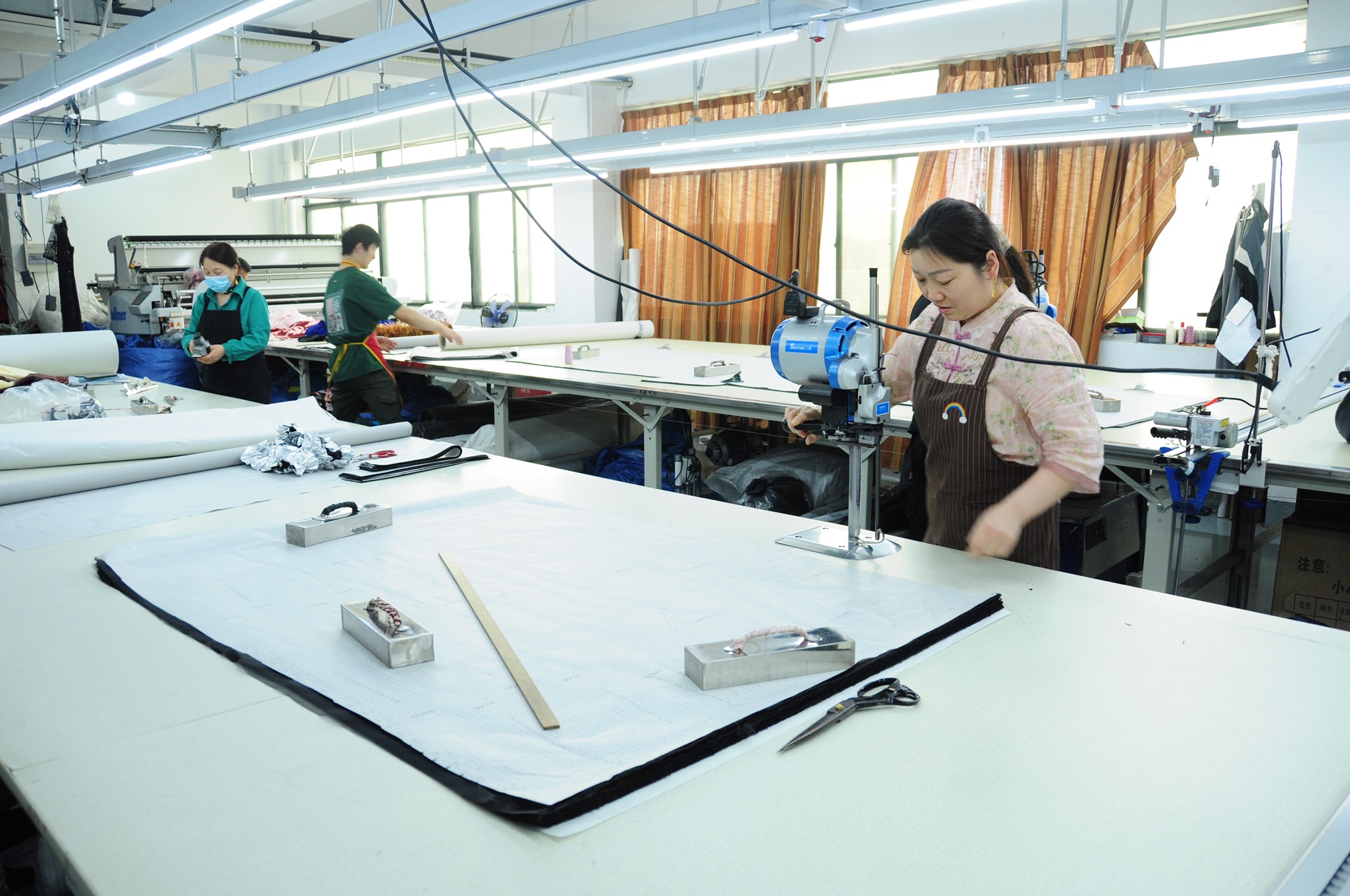
Evaluation standard: The supplier can demonstrate experience with comparable fabrics, construction methods, and quality requirements—not merely a broad product list.
Lead time: What must happen before production starts?
Ask the factory to break the schedule into stages: sample development, revisions, material sourcing, production, inspection, and dispatch. Clarify who approves each stage and what happens if materials or feedback arrive late.
Evaluation standard: Both sides agree on a written timeline with dependencies and approval points. Avoid treating an estimated production time as a confirmed delivery date.
Communication: Can the factory turn your instructions into action?
A useful supplier should ask questions about unclear details rather than silently making assumptions. Provide a clear specification and note how the team responds.
Evaluation standard: The factory identifies missing information, summarizes decisions, assigns a contact, and confirms changes in writing.
2. Common Mistakes Buyers Should Avoid
Mistake 1: Choosing on price alone. A low quote may exclude fabric, packaging, testing, revisions, or shipping. Request an itemized quotation and compare the same scope across suppliers.
Mistake 2: Assuming a certificate covers everything. A valid document may apply only to certain materials, products, sites, or processes. Verify its scope against your order.
Mistake 3: Approving appearance but not construction. A sample can look good in photos while having problems with measurements, stitching, lining, or finishing. Review the physical sample against the specification.
Mistake 4: Leaving quality standards until the end. Agree on measurements, tolerances, inspection points, labeling, and acceptance criteria before bulk production.
Mistake 5: Treating a sample lead time as a bulk-order promise. Material availability, revisions, and production slots can all affect the final schedule. Confirm each stage separately.
3. From Sample to Bulk: An Example Using Jindian Fabric
Jindian Fabric offers services covering fabric development, pattern making, sampling, material sourcing or customer-supplied materials, garment production, finishing, inspection, and delivery. A buyer can use the following sequence to structure a project:
Step 1: Send the brief
Provide a design sketch, sample, or technical pack, together with the target market, quantities, size range, fabric preferences, and required delivery window. Jindian Fabric lists sizes 6–16 or production according to a customer-provided measurement chart.
Step 2: Discuss feasibility and quotation
Review fabric choices, construction, quantities, packaging, and whether materials will be sourced by the factory or supplied by the buyer. Jindian Fabric states that pricing is based on the style and workmanship. Confirm what the quote includes and excludes.
Step 3: Develop and review the sample
The factory makes a pattern and sample based on the agreed brief. Check fit, measurements, fabric behavior, workmanship, and finishing. Record any revisions clearly.
Step 4: Approve specifications before bulk production
Confirm the final sample and written specifications, including materials, colors, labels, size grading, packaging, inspection requirements, and delivery terms.
Step 5: Produce, inspect, and deliver
Once materials and approvals are in place, the order can proceed through cutting, sewing, finishing, packing, and quality checks. Agree in advance how inspection results and any quality concerns will be handled.
Buyer’s tip: Keep the approved sample and final specification together as your reference. If changes are made later, document who approved them and how they affect price or timing.
4. Small-Batch Orders and Quick Reorders
Testing a new style should not require guessing your way through the process.
Ask for a style-specific minimum order quantity. A factory may support small orders, but the workable quantity can depend on fabric, color, size distribution, and workmanship.
Consider material constraints early. Fabric and trim suppliers may have their own minimums and lead times, even when the garment factory accepts a small order.
Keep the first range manageable. Prioritize the styles, colors, and sizes most important to your test.
Plan for repeatability. Save the final pattern, measurements, material specifications, and approved sample details so a reorder starts from an agreed reference.
Discuss replenishment before launch. Ask about material availability, production slots, and the approval process for repeat orders. A quick-reorder service is useful, but the actual turnaround must be confirmed for each order.
Jindian Fabric says it supports small-batch orders, multiple styles, and replenishment orders. Buyers should discuss their actual quantities and schedule with the company before relying on those options.
FAQ
Is BSCI enough to prove a clothing manufacturer is qualified?
No single audit or certification answers every sourcing question. BSCI is relevant to social-responsibility assessment, while product requirements, manufacturing capability, quality controls, and delivery arrangements also need review.
What is the difference between OEM and ODM?
In an OEM arrangement, the buyer generally provides the design or specifications for the manufacturer to produce. In an ODM arrangement, the manufacturer may also contribute design or development services. The precise division of work should be agreed in the project brief.
Can I send my own fabric?
Jindian Fabric states that it offers both material sourcing and processing with customer-supplied materials. Before shipping fabric, agree on inspection, quantities, responsibility for shortages or defects, and handling of leftover material.
How do I confirm whether a certificate applies to my order?
Request the certificate or audit documentation, check its validity and scope, and use the relevant scheme’s verification process where available. If anything is unclear, ask the supplier or certification body before making a claim about the finished product.
Ready to Evaluate a Manufacturer?
Hangzhou Jindian Fabric Co., Ltd. is worth discussing if you are sourcing women’s apparel, need fabric-development support, or want to explore small-batch production. Start with your product requirements and request current credentials, a sample plan, and a quotation tailored to your order.
Contact: Eric Zhou
Email: ERIC@HZJINDIAN.COM
Official website: Search for “Hangzhou Jindian Fabric Co., Ltd.” to find the company’s official site.
Connect: Email your design sketch, technical pack, or sample requirements to begin the discussion.
